> ## Documentation Index
> Fetch the complete documentation index at: https://rajanand.org/llms.txt
> Use this file to discover all available pages before exploring further.
# Introduction to Data Engineering: Overview
## Data Engineering Evolution and Fundamentals
1. **Evolution of Data Engineering**
* **Early Days**:
* Data engineers were originally software engineers focused on building software applications.
* Data generated by these applications was seen as a byproduct or "exhaust," useful mainly for troubleshooting or monitoring.
* **Shift in Perspective**:
* Organizations began to recognize the intrinsic value of data as its volume and variety grew.
* Software engineers started building systems specifically for data ingestion, storage, transformation, and serving.
* **Emergence of Data Engineering**:
* Data engineering became a central function in organizations.
* The role of a data engineer was born to focus on managing data systems and pipelines.
2. **Definition of Data Engineering**
* **Core Definition**:
* Data engineering involves developing, implementing, and maintaining systems that take raw data and produce high-quality, consistent information for downstream use cases like analysis and machine learning.
* **Key Components**:
* Data engineering sits at the intersection of:
* **Security**
* **Data Management**
* **DataOps**
* **Data Architecture**
* **Orchestration**
* **Software Engineering**
3. **Data Engineering Life Cycle**
* **Stages of the Life Cycle**:
1. **Data Generation**: Data is created by source systems (e.g., software applications, user-generated data, sensors).
2. **Ingestion**: Data is collected from source systems.
3. **Transformation**: Data is processed and transformed into a usable format.
4. **Storage**: Data is stored, often spanning across ingestion, transformation, and serving stages.
5. **Serving**: Data is made available for end-use cases.
* **End Use Cases**:
* Analytics, machine learning, and Reverse ETL (sending processed data back to source systems for additional value).
* **Data Pipeline**:
* A combination of architecture, systems, and processes that move data through the stages of the life cycle.
4. **Undercurrents of Data Engineering**
* **Undercurrents**:
* These are overarching themes that span the entire data engineering life cycle:
1. **Security**: Ensuring data is protected.
2. **Data Management**: Organizing and maintaining data.
3. **DataOps**: Streamlining data operations.
4. **Data Architecture**: Designing data systems.
5. **Orchestration**: Coordinating data workflows.
6. **Software Engineering**: Building and maintaining data systems.
* **Relevance**:
* Each undercurrent is relevant to all stages of the data engineering life cycle.
5. **Holistic Approach to Data Engineering**
* **Focus on Value**:
* Data engineers should think holistically about the life cycle and undercurrents to deliver real value to the organization.
* **Stakeholder Needs**:
* Transforming stakeholder needs into system requirements is key to providing value.
***
## History and Evolution of Data Engineering
1. **Data is Everywhere**
* **Definition of Data**:
* Data comprises the building blocks of information.
* It can take many forms: words, numbers, photons, wind, etc.
* **Recording Data**: Data can be recorded as memories, writings, or digitally (e.g., videos, computer files).
* **Digital Data**: "Data" refers to digitally recorded data that can be stored on computers or transmitted over the internet.
2. **The Birth of Digital Data**
* **1960s**: The advent of computers led to the creation of the first computerized databases.
* **1970s**: Relational databases emerged.
* IBM developed **[SQL](/sql/overview) (Structured Query Language)**.
* **1980s**: Bill Inmon developed the first **[data warehouse](/glossary/data-warehouse)** to support analytical decision-making.
* **1990s**:
* Growth of data systems led to the need for dedicated tools and pipelines for reporting and business intelligence.
* **Ralph Kimball** and **Bill Inmon** developed data modeling approaches for analytics.
* The internet went mainstream, leading to the rise of web-first companies like Amazon.
* Backend systems (servers, databases, storage) emerged to support web applications.
3. **The Big Data Era**
* **Early 2000s**:
* After the dotcom bust, companies like Yahoo, Google, and Amazon faced an explosion of data.
* Traditional relational databases and data warehouses couldn't handle the scale.
* **Definition of Big Data**:
* Extremely large datasets analyzed computationally to reveal patterns, trends, and associations.
* Characterized by the **3 Vs**:
1. **Velocity**: High speed of data generation.
2. **Variety**: Diverse types of data.
3. **Volume**: Large amounts of data.
* **2004**: Google published the **MapReduce** paper, a scalable data processing paradigm.
* **2006**: Yahoo developed and open-sourced **Apache Hadoop**, a revolutionary big data tool.
* **Impact of Hadoop**:
* Drew software engineers to large-scale data problems.
* Marked the beginning of the **big data engineer** role.
4. **The Rise of Cloud Computing**
* **Amazon Web Services (AWS)**:
* Created scalable solutions like **EC2 (Elastic Cloud Compute)**, **S3 (Simple Storage Service)**, and **DynamoDB**.
* AWS became the first popular **public cloud**, offering pay-as-you-go compute and storage.
* Google Cloud Platform and Microsoft Azure followed AWS.
* **Impact of the Cloud**:
* Revolutionized how software and data applications are developed and deployed.
* Enabled startups to access the same tools as top tech companies.
5. **Transition to Real-Time Data**
* **Shift from Batch to Event Streaming**: Batch processing (analyzing data in chunks) gave way to **event streaming** (handling data as a continuous flow).
* **Big Real-Time Data**: Real-time data processing became a new focus.
6. **The Decline of "Big Data" as a Term**
* **Challenges of Big Data Tools**:
* Managing tools like Hadoop required significant effort and cost.
* Big data engineers spent more time maintaining systems than delivering business value.
* **Modern Data Engineering**:
* Big data processing became more accessible.
* The term "big data" lost momentum as all companies, regardless of size, aimed to derive value from their data.
* Big data engineers are now simply **data engineers**.
7. **The Modern Data Ecosystem**
* **2010s**:
* Emergence of **Cloud-first**, **open-source**, and **third-party products** simplified working with data at scale.
* **Data Engineering Today**:
* Focuses on **interoperability** and connecting various technologies like Lego bricks.
* Data engineers are higher up the value chain, contributing directly to business goals.
* **Opportunities for Data Engineers**:
* Build scalable data systems using advanced tools.
* Contribute to the development of new technologies.
* Play a central role in achieving business strategy across industries.
***
## Stakeholder Management in Data Engineering
**Overview of the Data Engineer's Role**
* A data engineer's primary task is to:
1. Acquire raw data.
2. Transform it into a useful format.
3. Make it available for downstream use cases.
* Success depends on understanding the needs of downstream data consumers to add value.
**Downstream Stakeholders**
* **Key Use Cases**: Analytics and machine learning.
* **Potential Stakeholders**:
* Business professionals (e.g., sales, marketing, executives)
* Data scientists, Machine learning engineers
* Analysts
* **Example: Supporting Business Analysts**
* Analysts use SQL queries to generate dashboards, analyze trends, and predict metrics.
* Questions to consider for serving analysts:
1. Query frequency for dashboard refreshes.
2. Information needed in queries.
3. Preprocessing needs like joins and aggregations for better performance.
4. Latency tolerance (e.g., real-time data vs. hourly/daily updates).
* **Data Definitions**: Ensure alignment on metrics definitions (e.g., time zones for daily sales totals).
* **Key Considerations**:
* Engage in company strategy to identify potential business value from data.
* Understand metrics and priorities important to downstream stakeholders.
**Upstream Stakeholders**
* **Who Are They?**
* Source system owners, often software engineers, responsible for systems generating raw data.
* These can be: Internal software engineers and external third-party system developers.
* **Data Engineer's Role as a Consumer**:
* Communicate with source system owners to understand:
1. Volume, frequency, and format of raw data.
2. Security and compliance considerations.
* Develop relationships to:
* Influence how data is served.
* Receive advance notice of changes (e.g., outages, schema updates).
* **Dealing with External Systems**:
* While external systems are often beyond direct control, connecting with their owners provides valuable insights into the source application.
\*\* Key Takeaways\*\*
* **Stakeholder Categories**:
1. **Downstream stakeholders**: Rely on transformed data to meet their goals.
2. **Upstream stakeholders**: Provide the raw data needed for engineering pipelines.
* **Best Practices**:
* Understand how upstream disruptions impact pipelines.
* Ensure data served downstream aligns with organizational goals and adds measurable value.
***
## Business Value
**Role of a Data Engineer**
1. **Key Responsibility**: Transform raw data into useful data and make it accessible for downstream use cases.
2. **Understanding Downstream Consumers**:
* Engage deeply with downstream stakeholders to understand their requirements.
* Downstream consumers could include: Analysts, data scientists, machine learning engineers, and other decision-makers (e.g., salespeople, product managers, executives).
3. **Tailoring Solutions**:
* Example: Serving a business analyst:
* Understand query frequency, latency tolerance, and specific data definitions.
* Align on critical metrics like time zones or aggregation logic.
* Provide pre-aggregated data or optimized query structures for faster results.
4. **Aligning with Business Goals**:
* Be aware of the company’s strategy to align data solutions with organizational goals.
* Understand key business metrics and their significance.
**Stakeholder Management**
1. **Downstream Stakeholders**:
* Value comes from enabling stakeholders to meet their objectives (e.g., trend analysis, dashboard creation, predictions).
* Addressing stakeholders' requirements enhances data usability and business impact.
2. **Upstream Stakeholders**:
* Collaborate with software engineers or third-party system developers to:
* Understand source data formats, volumes, and frequencies.
* Plan for potential data flow disruptions, schema changes, or security compliance.
* Maintain open communication for proactive issue resolution.
3. **Two-Way Interaction**:
* Downstream stakeholders rely on you for valuable data delivery.
* You depend on upstream systems for accurate, consistent raw data.
**Importance of Business Value**
1. **Core Principle**: Success as a data engineer is tied to delivering measurable business value.
2. **Expert Insights**:
* Advice from Bill Inman:
* Focus on projects that bring tangible business value rather than chasing the latest technologies.
* Align technical efforts with areas that impact revenue, cost savings, or efficiency.
3. **Perception of Value**:
* Stakeholders judge value based on how solutions help achieve their goals:
* Increased revenue.
* Cost efficiency.
* Simplified workflows.
* Successful product launches.
**Challenges in Adding Value**
1. **Managing Conflicting Needs**:
* Stakeholder demands may exceed available resources or capacity.
* Prioritization of projects becomes crucial:
* Focus on feasible projects with high impact.
* Estimate timelines and resource requirements.
2. **Strategic Decision-Making**:
* Effective prioritization requires balancing stakeholder goals with organizational constraints.
***
## System Requirements
1. **Understand the Types of Requirements:**
* **Business Requirements:** High-level organizational goals (e.g., increase revenue or grow user base).
* **Stakeholder Requirements:** Individual needs to accomplish tasks (e.g., accurate reports, anomaly detection).
* **System Requirements:**
* **Functional Requirements:** The "what" the system must do (e.g., data pipeline schedules).
* **Non-Functional Requirements:** The "how" the system operates (e.g., performance, scalability, and compliance).
2. **The Requirement Gathering Process:**
* **Not Unique to Data Engineering**:
* Commonly used in product development and management.
* The process involves understanding stakeholder needs and translating them into system requirements.
* **Start with Stakeholder Conversations:**
* Understand their roles, goals, and technical background.
* Identify how their work ties into broader business objectives.
* **Translate Needs into Requirements:**
* Break down broad goals into actionable system features.
* Include technical specifications and constraints (e.g., memory limits, budget).
* **Steps in Requirements Gathering**:
1. **Identify Business Goals**: Understand the high-level objectives of the organization.
2. **Identify Stakeholders**: Determine who will use or benefit from the data system.
3. **Understand Current Systems**: Learn about existing systems and their limitations.
4. **Define Stakeholder Needs**: Gather detailed requirements from stakeholders.
5. **Determine Functional and Non-Functional Requirements**:
* **Functional Requirements**: What the system must do (e.g., generate reports, support queries).
* **Non-Functional Requirements**: How the system should perform (e.g., latency, scalability, security).
3. **Anticipate Constraints:** Address cost limitations and compliance with security and regulatory standards early in the planning process.
4. **Iterative Collaboration:** Recognize stakeholders’ perspectives evolve, and refine requirements iteratively.
5. **Skill Development:**
* Enhance communication skills for varied technical audiences.
* Develop systems thinking to bridge abstract goals with concrete implementations.
**Actionable Approach**
1. **Prepare for Stakeholder Meetings:**
* Research the business area or department's goals.
* Prepare questions to uncover unspoken needs.
2. **Draft Requirement Templates:** Create templates for functional and non-functional requirements to organize your findings.
3. **Review with Stakeholders:** Regularly validate the gathered requirements to ensure alignment with expectations.
4. **Bridge Communication Gaps:** Use visualization tools (e.g., workflows, diagrams) to clarify complex system ideas to less technical stakeholders.
5. **Balance Prioritization:** Evaluate feasibility based on impact and resources while ensuring essential requirements are met.
***
## Thinking Like a Data Engineer
1. **Thinking Like a Data Engineer: A Framework**
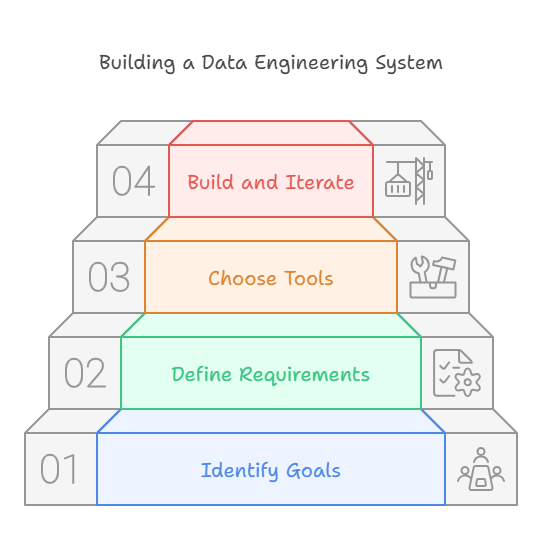
 * **Stage 1: Identify Business Goals and Stakeholder Needs**:
* **Objective**: Understand the business goals and how stakeholder needs align with them.
* **Key Actions**:
* Clarify high-level business goals.
* Identify stakeholders and their needs.
* Conduct conversations with stakeholders to understand their pain points and expectations.
* Ask stakeholders what actions they plan to take with the data products (e.g., dashboards, machine learning models).
* **Stage 2: Define Functional and Non-Functional Requirements**:
* **Objective**: Translate stakeholder needs into clear system requirements.
* **Key Actions**:
* Document functional requirements (what the system must do).
* Define non-functional requirements (how the system should perform).
* Confirm with stakeholders that the documented requirements will meet their needs.
* **Stage 3: Choose Tools and Technologies**:
* **Objective**: Select the best tools and technologies to meet the requirements.
* **Key Actions**:
* Identify tools and technologies that can meet the requirements.
* Evaluate trade-offs between tools (e.g., cost, scalability, ease of use).
* Perform a cost-benefit analysis (e.g., licensing fees, cloud resource costs).
* Build a prototype to test the chosen tools and technologies.
* **Stage 4: Build, Deploy, and Iterate**:
* **Objective**: Implement the system and continuously improve it.
* **Key Actions**:
* Build and deploy the data system.
* Continuously monitor and evaluate system performance.
* Iterate on the system to adapt to changing stakeholder needs or new technologies.
3. **Key Considerations in the Framework**
* **Prototyping/POC**:
* Before fully building the system, create a prototype to test whether it meets stakeholder needs.
* Iterate on the prototype to ensure the final system will deliver value.
* **Evolution of Data Systems**:
* Data systems are not static; they must evolve as business goals and stakeholder needs change.
* Regularly communicate with stakeholders to ensure the system continues to meet their needs.
* **Cyclical Process**: The framework is not linear but cyclical. As needs and technologies change, revisit earlier stages to update the system.
[Source](https://link.rajanand.org/introduction-to-data-engineering-coursera): DeepLearning.ai data engineering course.
* **Stage 1: Identify Business Goals and Stakeholder Needs**:
* **Objective**: Understand the business goals and how stakeholder needs align with them.
* **Key Actions**:
* Clarify high-level business goals.
* Identify stakeholders and their needs.
* Conduct conversations with stakeholders to understand their pain points and expectations.
* Ask stakeholders what actions they plan to take with the data products (e.g., dashboards, machine learning models).
* **Stage 2: Define Functional and Non-Functional Requirements**:
* **Objective**: Translate stakeholder needs into clear system requirements.
* **Key Actions**:
* Document functional requirements (what the system must do).
* Define non-functional requirements (how the system should perform).
* Confirm with stakeholders that the documented requirements will meet their needs.
* **Stage 3: Choose Tools and Technologies**:
* **Objective**: Select the best tools and technologies to meet the requirements.
* **Key Actions**:
* Identify tools and technologies that can meet the requirements.
* Evaluate trade-offs between tools (e.g., cost, scalability, ease of use).
* Perform a cost-benefit analysis (e.g., licensing fees, cloud resource costs).
* Build a prototype to test the chosen tools and technologies.
* **Stage 4: Build, Deploy, and Iterate**:
* **Objective**: Implement the system and continuously improve it.
* **Key Actions**:
* Build and deploy the data system.
* Continuously monitor and evaluate system performance.
* Iterate on the system to adapt to changing stakeholder needs or new technologies.
3. **Key Considerations in the Framework**
* **Prototyping/POC**:
* Before fully building the system, create a prototype to test whether it meets stakeholder needs.
* Iterate on the prototype to ensure the final system will deliver value.
* **Evolution of Data Systems**:
* Data systems are not static; they must evolve as business goals and stakeholder needs change.
* Regularly communicate with stakeholders to ensure the system continues to meet their needs.
* **Cyclical Process**: The framework is not linear but cyclical. As needs and technologies change, revisit earlier stages to update the system.
[Source](https://link.rajanand.org/introduction-to-data-engineering-coursera): DeepLearning.ai data engineering course.