> ## Documentation Index
> Fetch the complete documentation index at: https://rajanand.org/llms.txt
> Use this file to discover all available pages before exploring further.
# Data Engineering Undercurrents
### **Overview**
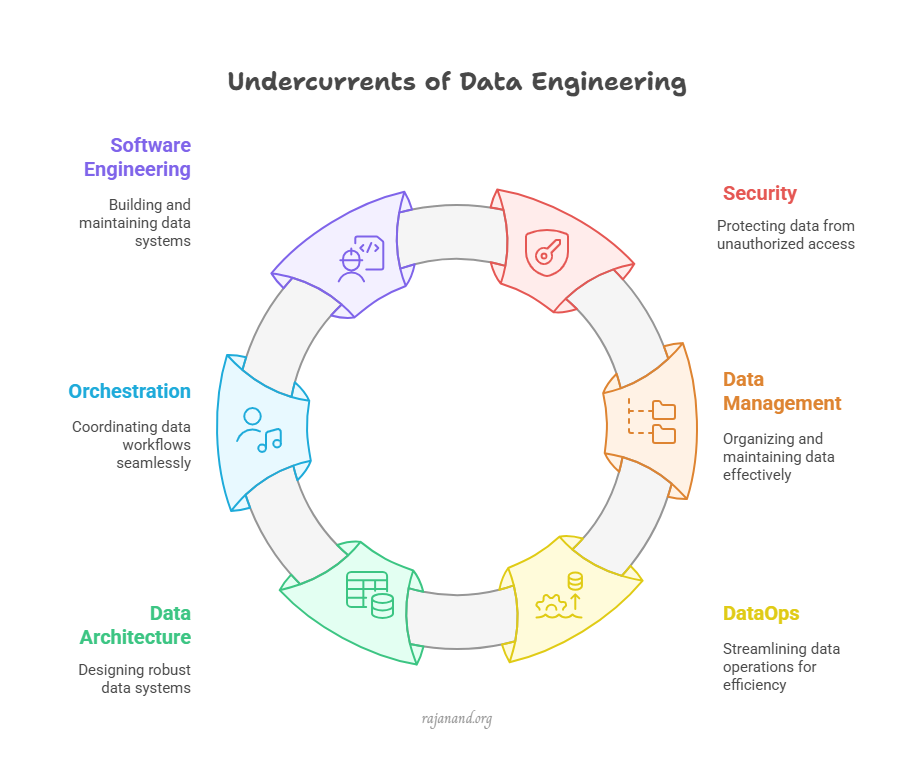
* **Undercurrents**:
* Practices that apply across the entire data engineering lifecycle:
1. **Security**
2. **Data Management**
3. **Data Architecture**
4. **DataOps**
5. **Orchestration**
6. **Software Engineering**
 ### **Security**
* **Core Principle**: Protect sensitive data (e.g., personal, proprietary).
* **Key Practices**:
* **Principle of Least Privilege**: Grant users/applications only the access they need.
* **Data Sensitivity**: Avoid ingesting sensitive data unless absolutely necessary.
* **Cloud Security**: Understand **IAM (Identity and Access Management)**, encryption, and networking protocols.
* **Cultural Aspect**:
* Security is a **shared responsibility** across the organization.
* Avoid **security theater** (superficial compliance without a true security culture).
* **Common Mistakes**:
* Exposing S3 buckets or databases to the public internet.
* Ignoring basic precautions like secure password sharing.
* **Key Takeaway**: Security is about **principles, protocols, and people**.
### **Data Management**
* **Definition**: The development, execution, and supervision of plans to deliver, control, protect, and enhance the value of data.
* **DAMA (Data Management Association)**:
* Provides the **Data Management Body of Knowledge (DMBOK)**.
* Covers 11 knowledge areas, including **data governance**, **data modeling**, and **data integration**.
### **Security**
* **Core Principle**: Protect sensitive data (e.g., personal, proprietary).
* **Key Practices**:
* **Principle of Least Privilege**: Grant users/applications only the access they need.
* **Data Sensitivity**: Avoid ingesting sensitive data unless absolutely necessary.
* **Cloud Security**: Understand **IAM (Identity and Access Management)**, encryption, and networking protocols.
* **Cultural Aspect**:
* Security is a **shared responsibility** across the organization.
* Avoid **security theater** (superficial compliance without a true security culture).
* **Common Mistakes**:
* Exposing S3 buckets or databases to the public internet.
* Ignoring basic precautions like secure password sharing.
* **Key Takeaway**: Security is about **principles, protocols, and people**.
### **Data Management**
* **Definition**: The development, execution, and supervision of plans to deliver, control, protect, and enhance the value of data.
* **DAMA (Data Management Association)**:
* Provides the **Data Management Body of Knowledge (DMBOK)**.
* Covers 11 knowledge areas, including **data governance**, **data modeling**, and **data integration**.
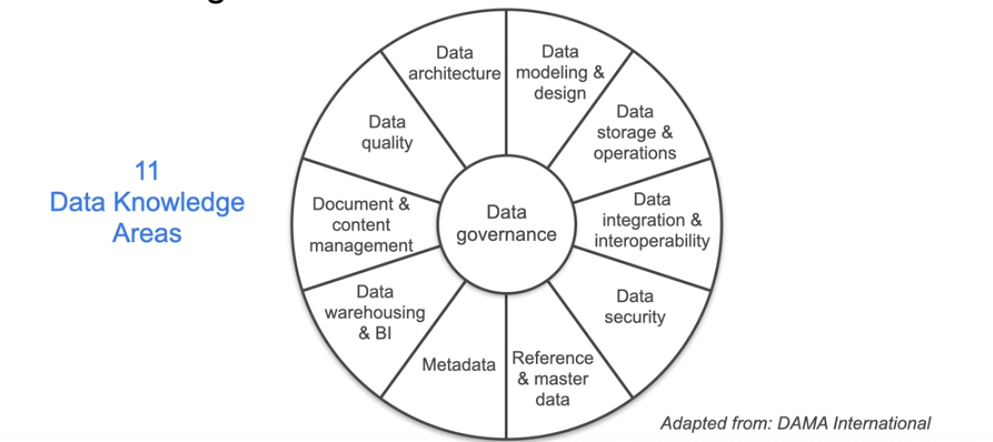 * **Data Governance**:
* Ensures **data quality**, **integrity**, **security**, and **usability**.
* Central to all other data management areas.
* **Data Quality**:
* High-quality data is **accurate**, **complete**, **discoverable**, and **timely**.
* Poor data quality leads to wasted time, poor decisions, and loss of trust.
* **Key Takeaway**: Data management ensures data is a **valuable business asset**.
### **Data Architecture**
* **Definition**: The design of systems to support the evolving data needs of an enterprise through flexible and reversible decisions.
* **Key Principles**:
1. **Choose Common Components Wisely**: Use components that facilitate collaboration.
2. **Plan for Failure**: Design for both success and failure scenarios.
3. **Architect for Scalability**: Build systems that scale up and down with demand.
4. **Architecture is Leadership**: Think like an architect to lead and mentor others.
5. **Always Be Architecting**: Continuously evolve systems to meet changing needs.
6. **Build Loosely Coupled Systems**: Use interchangeable components for flexibility.
7. **Make Reversible Decisions**: Ensure design choices can be easily changed.
8. **Prioritize Security**: Apply security principles like least privilege and zero trust.
9. **Embrace FinOps**: Optimize costs while maximizing revenue potential.
* **Key Takeaway**: Good data architecture is **flexible**, **scalable**, and **secure**.
### **DataOps**
* **Definition**: A set of cultural habits and practices borrowed from **DevOps** to improve the development and quality of data products.
* **Key Pillars**:
1. **Automation**:
* Use **CI/CD (Continuous Integration/Continuous Delivery)** for data pipelines.
* Automate tasks like ingestion, transformation, and serving.
2. **Observability and Monitoring**:
* Monitor pipelines to detect failures early.
* Avoid bad data lingering in reports or dashboards.
3. **Incident Response**:
* Rapidly identify and resolve issues.
* Foster open and blameless communication.
* **Key Takeaway**: DataOps improves **efficiency**, **quality**, and **reliability** of data systems.
### **Orchestration**
* **Definition**: Coordinating and managing tasks in data pipelines.
* **Approaches**:
1. **Manual Execution**: Useful for prototyping but not sustainable.
2. **Pure Scheduling**: Automate tasks at specific times but lacks dependency management.
3. **Orchestration Frameworks**:
* Tools like **Apache Airflow**, **Dagster**, **Prefect**, and **Mage**.
* Automate tasks with **dependencies** and **monitoring**.
* **Directed Acyclic Graphs (DAGs)**:
* Represent data pipelines as flowcharts with **nodes** (tasks) and **edges** (dependencies).
* Ensure data flows in one direction without loops.
* **Key Takeaway**: Orchestration frameworks automate and optimize data pipelines.
### **Software Engineering**
* **Core Skill**: Write **clean**, **readable**, **testable**, and **deployable** code.
* **Languages and Frameworks**:
* **SQL**, **Python**, **Bash**, **Spark**, **Kafka**, **Java**, **Scala**, **Rust**, **Go**.
* **Key Areas**:
* **Data Processing**: Write code for ingestion, transformation, and serving.
* **Open Source Contributions**: Contribute to frameworks like Apache Airflow.
* **Infrastructure as Code**: Automate infrastructure setup using code.
* **Key Takeaway**: Strong software engineering skills are essential for **adding value** as a data engineer.
### **Key Takeaways**
1. **Undercurrents**:
* Security, Data Management, DataOps, Data Architecture, Orchestration, and Software Engineering are foundational to data engineering.
2. **Security**:
* Protect data through **least privilege**, **encryption**, and a **security-first culture**.
3. **Data Management**:
* Ensure data is **high-quality**, **secure**, and **usable** through governance and best practices.
4. **Data Architecture**:
* Design **flexible**, **scalable**, and **secure** systems that evolve with business needs.
5. **DataOps**:
* Automate, monitor, and respond to incidents to improve **efficiency** and **reliability**.
6. **Orchestration**:
* Use frameworks like **Apache Airflow** to automate and manage complex data pipelines.
7. **Software Engineering**:
* Write **production-grade code** to build and maintain robust data systems.
***
[Source](https://link.rajanand.org/introduction-to-data-engineering-coursera): DeepLearning.ai data engineering course.
* **Data Governance**:
* Ensures **data quality**, **integrity**, **security**, and **usability**.
* Central to all other data management areas.
* **Data Quality**:
* High-quality data is **accurate**, **complete**, **discoverable**, and **timely**.
* Poor data quality leads to wasted time, poor decisions, and loss of trust.
* **Key Takeaway**: Data management ensures data is a **valuable business asset**.
### **Data Architecture**
* **Definition**: The design of systems to support the evolving data needs of an enterprise through flexible and reversible decisions.
* **Key Principles**:
1. **Choose Common Components Wisely**: Use components that facilitate collaboration.
2. **Plan for Failure**: Design for both success and failure scenarios.
3. **Architect for Scalability**: Build systems that scale up and down with demand.
4. **Architecture is Leadership**: Think like an architect to lead and mentor others.
5. **Always Be Architecting**: Continuously evolve systems to meet changing needs.
6. **Build Loosely Coupled Systems**: Use interchangeable components for flexibility.
7. **Make Reversible Decisions**: Ensure design choices can be easily changed.
8. **Prioritize Security**: Apply security principles like least privilege and zero trust.
9. **Embrace FinOps**: Optimize costs while maximizing revenue potential.
* **Key Takeaway**: Good data architecture is **flexible**, **scalable**, and **secure**.
### **DataOps**
* **Definition**: A set of cultural habits and practices borrowed from **DevOps** to improve the development and quality of data products.
* **Key Pillars**:
1. **Automation**:
* Use **CI/CD (Continuous Integration/Continuous Delivery)** for data pipelines.
* Automate tasks like ingestion, transformation, and serving.
2. **Observability and Monitoring**:
* Monitor pipelines to detect failures early.
* Avoid bad data lingering in reports or dashboards.
3. **Incident Response**:
* Rapidly identify and resolve issues.
* Foster open and blameless communication.
* **Key Takeaway**: DataOps improves **efficiency**, **quality**, and **reliability** of data systems.
### **Orchestration**
* **Definition**: Coordinating and managing tasks in data pipelines.
* **Approaches**:
1. **Manual Execution**: Useful for prototyping but not sustainable.
2. **Pure Scheduling**: Automate tasks at specific times but lacks dependency management.
3. **Orchestration Frameworks**:
* Tools like **Apache Airflow**, **Dagster**, **Prefect**, and **Mage**.
* Automate tasks with **dependencies** and **monitoring**.
* **Directed Acyclic Graphs (DAGs)**:
* Represent data pipelines as flowcharts with **nodes** (tasks) and **edges** (dependencies).
* Ensure data flows in one direction without loops.
* **Key Takeaway**: Orchestration frameworks automate and optimize data pipelines.
### **Software Engineering**
* **Core Skill**: Write **clean**, **readable**, **testable**, and **deployable** code.
* **Languages and Frameworks**:
* **SQL**, **Python**, **Bash**, **Spark**, **Kafka**, **Java**, **Scala**, **Rust**, **Go**.
* **Key Areas**:
* **Data Processing**: Write code for ingestion, transformation, and serving.
* **Open Source Contributions**: Contribute to frameworks like Apache Airflow.
* **Infrastructure as Code**: Automate infrastructure setup using code.
* **Key Takeaway**: Strong software engineering skills are essential for **adding value** as a data engineer.
### **Key Takeaways**
1. **Undercurrents**:
* Security, Data Management, DataOps, Data Architecture, Orchestration, and Software Engineering are foundational to data engineering.
2. **Security**:
* Protect data through **least privilege**, **encryption**, and a **security-first culture**.
3. **Data Management**:
* Ensure data is **high-quality**, **secure**, and **usable** through governance and best practices.
4. **Data Architecture**:
* Design **flexible**, **scalable**, and **secure** systems that evolve with business needs.
5. **DataOps**:
* Automate, monitor, and respond to incidents to improve **efficiency** and **reliability**.
6. **Orchestration**:
* Use frameworks like **Apache Airflow** to automate and manage complex data pipelines.
7. **Software Engineering**:
* Write **production-grade code** to build and maintain robust data systems.
***
[Source](https://link.rajanand.org/introduction-to-data-engineering-coursera): DeepLearning.ai data engineering course.