> ## Documentation Index
> Fetch the complete documentation index at: https://rajanand.org/llms.txt
> Use this file to discover all available pages before exploring further.
# Data Engineering Lifecycle
### **Overview**
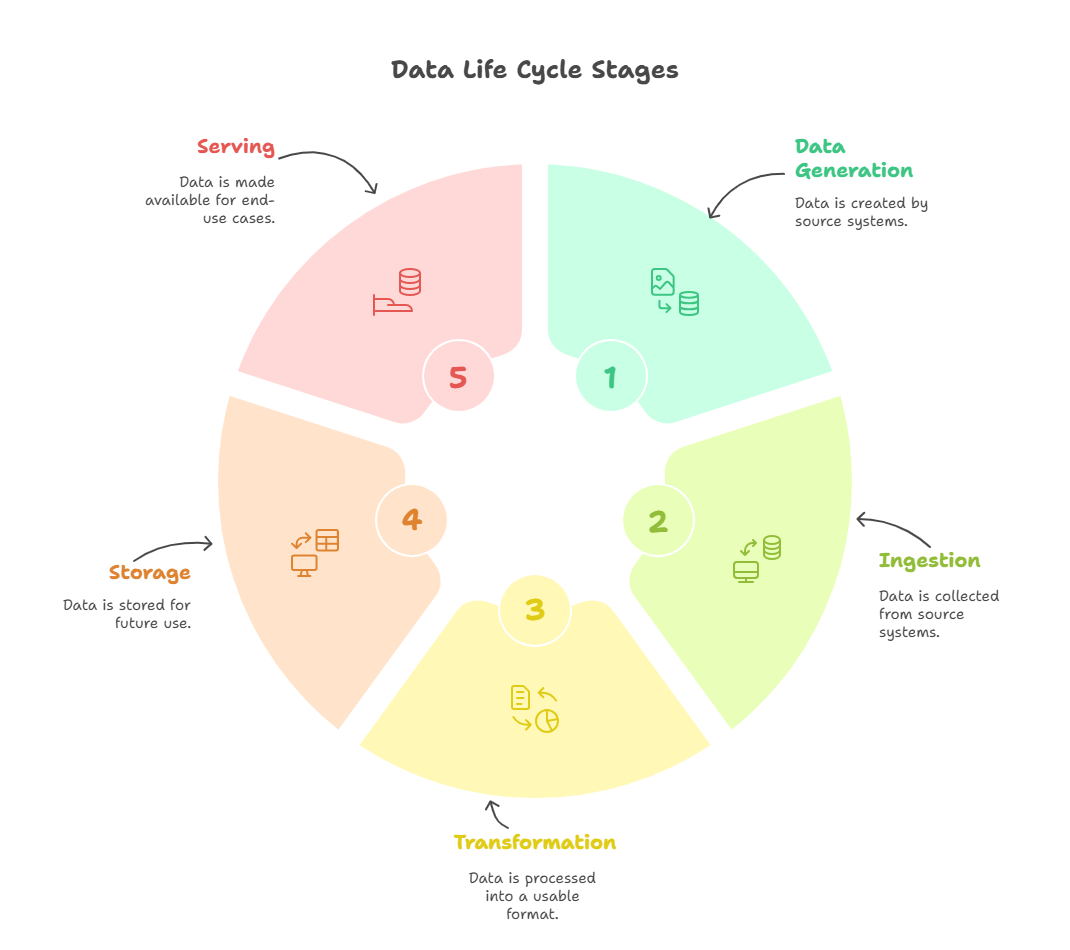
* **Lifecycle Stages**:
1. **Data Generation**: Happens before the data engineer's role begins.
2. **Ingestion**: Moving raw data into the pipeline.
3. **Transformation**: Turning raw data into something useful.
4. **Storage**: Storing data for further use.
5. **Serving**: Making data available for downstream use cases (e.g., analytics, machine learning).
 ### **Data Generation and Source Systems**
* **Role of Data Engineer**: Consume data from various sources (e.g., databases, APIs, IoT devices).
* **Common Source Systems**:
* **Databases**: Relational (SQL) or NoSQL (key-value, document stores).
* **Files**: Text, audio, video, etc.
* **APIs**: Fetch data in formats like JSON or XML.
* **Data Sharing Platforms**: Internal or third-party platforms.
* **IoT Devices**: Real-time data streams (e.g., GPS trackers).
* **Challenges**:
* Source systems are often maintained by other teams (e.g., software engineers).
* Data formats or schemas may change unexpectedly, disrupting pipelines.
* **Key Takeaway**: Build strong relationships with source system owners to understand data generation and anticipate changes.
### **Ingestion**
* **Definition**: Moving raw data from source systems into the pipeline for processing.
* **Ingestion Patterns**:
1. **Batch Ingestion**:
* Data is processed in chunks (e.g., hourly, daily).
* Common for analytics and machine learning.
2. **Streaming Ingestion**:
* Data is processed in near real-time (e.g., less than one second delay).
* Requires tools like event streaming platforms or message queues.
* **Trade-offs**:
* **Batch**: Simpler, cost-effective, but slower.
* **Streaming**: Faster, but more complex and expensive.
* **Key Considerations**:
* Use **streaming** only when justified by a business use case.
* Most pipelines combine **batch** and **streaming** components.
* **Change Data Capture (CDC)**: Trigger ingestion based on data changes in source systems.
* **Push vs. Pull**: Decide whether the source system pushes data or you pull it.
### **Storage**
* **Importance**: Storage systems determine the **function**, **performance**, and **limitations** of data pipelines.
* **Storage Hierarchy**:
1. **Raw Ingredients**:
* Physical: Magnetic disks, SSDs, RAM.
* Non-physical: Networking, CPU, serialization, compression, caching.
2. **Storage Systems**:
* Databases, object storage (e.g., Amazon S3), streaming storage.
3. **Storage Abstractions**:
* Data warehouses, data lakes, data lakehouses.
* **Key Considerations**:
* **Cost**: Magnetic disks are cheaper than SSDs or RAM.
* **Performance**: RAM is faster but volatile and expensive.
* **Scalability**: Distributed storage across clusters and data centers.
* **Common Mistakes**:
* Poorly designed ingestion (e.g., direct row inserts) can be slow and costly.
* Use **bulk ingestion** for large datasets to save time and money.
### **Queries, Modeling, and Transformation**
* **Transformation**: The stage where raw data is turned into something useful.
* **Components**:
1. **Queries**:
* Retrieve data from storage systems (e.g., using SQL).
* Poorly written queries can lead to performance issues or **row explosion**.
2. **Data Modeling**:
* Represent data in a way that reflects real-world relationships.
* **Normalization** vs. **Denormalization**: Balance complexity and query efficiency.
3. **Transformation**:
* Manipulate, enhance, and prepare data for downstream use.
* Examples: Adding timestamps, mapping data types, aggregating data.
* **Key Considerations**:
* Work with stakeholders to understand business goals and terminology.
* Ensure data models align with organizational workflows and logic.
### **Serving Data**
* **Purpose**: Make data available for downstream use cases to extract business value.
* **Common Use Cases**:
1. **Analytics**:
* **Business Intelligence (BI)**: Historical and current data for insights (e.g., dashboards, reports).
* **Operational Analytics**: Real-time data for immediate action (e.g., monitoring website performance).
* **Embedded Analytics**: Customer-facing analytics (e.g., bank spending dashboards, smart thermostat apps).
2. **Machine Learning**:
* Serve data for model training and real-time inference.
* Manage feature stores, metadata, and data lineage.
3. **Reverse ETL**:
* Push transformed data, analytics, or ML outputs back into source systems (e.g., CRM systems).
* **Key Considerations**:
* Tailor data serving to the specific needs of stakeholders.
* Ensure data is accessible, reliable, and timely.
### **Key Takeaways**
1. **Data Engineering Lifecycle**:
* Starts with **data generation** and ends with **serving data** for downstream use cases.
* Key stages: **Ingestion**, **Transformation**, **Storage**, and **Serving**.
2. **Undercurrents**: Security, Data Management, DataOps, Data Architecture, Orchestration, and Software Engineering underpin all stages of the lifecycle.
3. **Stakeholder Collaboration**: Work closely with **source system owners** and **downstream users** to ensure data pipelines meet business needs.
4. **Ingestion Patterns**: Choose between **batch** and **streaming** ingestion based on use case requirements.
5. **Storage Optimization**: Understand the hierarchy of storage systems and choose the right abstraction (e.g., data warehouse, data lake).
6. **Transformation**: Add value by querying, modeling, and transforming raw data into useful formats.
7. **Serving Data**: Deliver data for analytics, machine learning, and reverse ETL to drive business value.
***
[Source](https://link.rajanand.org/introduction-to-data-engineering-coursera): DeepLearning.ai data engineering course.
### **Data Generation and Source Systems**
* **Role of Data Engineer**: Consume data from various sources (e.g., databases, APIs, IoT devices).
* **Common Source Systems**:
* **Databases**: Relational (SQL) or NoSQL (key-value, document stores).
* **Files**: Text, audio, video, etc.
* **APIs**: Fetch data in formats like JSON or XML.
* **Data Sharing Platforms**: Internal or third-party platforms.
* **IoT Devices**: Real-time data streams (e.g., GPS trackers).
* **Challenges**:
* Source systems are often maintained by other teams (e.g., software engineers).
* Data formats or schemas may change unexpectedly, disrupting pipelines.
* **Key Takeaway**: Build strong relationships with source system owners to understand data generation and anticipate changes.
### **Ingestion**
* **Definition**: Moving raw data from source systems into the pipeline for processing.
* **Ingestion Patterns**:
1. **Batch Ingestion**:
* Data is processed in chunks (e.g., hourly, daily).
* Common for analytics and machine learning.
2. **Streaming Ingestion**:
* Data is processed in near real-time (e.g., less than one second delay).
* Requires tools like event streaming platforms or message queues.
* **Trade-offs**:
* **Batch**: Simpler, cost-effective, but slower.
* **Streaming**: Faster, but more complex and expensive.
* **Key Considerations**:
* Use **streaming** only when justified by a business use case.
* Most pipelines combine **batch** and **streaming** components.
* **Change Data Capture (CDC)**: Trigger ingestion based on data changes in source systems.
* **Push vs. Pull**: Decide whether the source system pushes data or you pull it.
### **Storage**
* **Importance**: Storage systems determine the **function**, **performance**, and **limitations** of data pipelines.
* **Storage Hierarchy**:
1. **Raw Ingredients**:
* Physical: Magnetic disks, SSDs, RAM.
* Non-physical: Networking, CPU, serialization, compression, caching.
2. **Storage Systems**:
* Databases, object storage (e.g., Amazon S3), streaming storage.
3. **Storage Abstractions**:
* Data warehouses, data lakes, data lakehouses.
* **Key Considerations**:
* **Cost**: Magnetic disks are cheaper than SSDs or RAM.
* **Performance**: RAM is faster but volatile and expensive.
* **Scalability**: Distributed storage across clusters and data centers.
* **Common Mistakes**:
* Poorly designed ingestion (e.g., direct row inserts) can be slow and costly.
* Use **bulk ingestion** for large datasets to save time and money.
### **Queries, Modeling, and Transformation**
* **Transformation**: The stage where raw data is turned into something useful.
* **Components**:
1. **Queries**:
* Retrieve data from storage systems (e.g., using SQL).
* Poorly written queries can lead to performance issues or **row explosion**.
2. **Data Modeling**:
* Represent data in a way that reflects real-world relationships.
* **Normalization** vs. **Denormalization**: Balance complexity and query efficiency.
3. **Transformation**:
* Manipulate, enhance, and prepare data for downstream use.
* Examples: Adding timestamps, mapping data types, aggregating data.
* **Key Considerations**:
* Work with stakeholders to understand business goals and terminology.
* Ensure data models align with organizational workflows and logic.
### **Serving Data**
* **Purpose**: Make data available for downstream use cases to extract business value.
* **Common Use Cases**:
1. **Analytics**:
* **Business Intelligence (BI)**: Historical and current data for insights (e.g., dashboards, reports).
* **Operational Analytics**: Real-time data for immediate action (e.g., monitoring website performance).
* **Embedded Analytics**: Customer-facing analytics (e.g., bank spending dashboards, smart thermostat apps).
2. **Machine Learning**:
* Serve data for model training and real-time inference.
* Manage feature stores, metadata, and data lineage.
3. **Reverse ETL**:
* Push transformed data, analytics, or ML outputs back into source systems (e.g., CRM systems).
* **Key Considerations**:
* Tailor data serving to the specific needs of stakeholders.
* Ensure data is accessible, reliable, and timely.
### **Key Takeaways**
1. **Data Engineering Lifecycle**:
* Starts with **data generation** and ends with **serving data** for downstream use cases.
* Key stages: **Ingestion**, **Transformation**, **Storage**, and **Serving**.
2. **Undercurrents**: Security, Data Management, DataOps, Data Architecture, Orchestration, and Software Engineering underpin all stages of the lifecycle.
3. **Stakeholder Collaboration**: Work closely with **source system owners** and **downstream users** to ensure data pipelines meet business needs.
4. **Ingestion Patterns**: Choose between **batch** and **streaming** ingestion based on use case requirements.
5. **Storage Optimization**: Understand the hierarchy of storage systems and choose the right abstraction (e.g., data warehouse, data lake).
6. **Transformation**: Add value by querying, modeling, and transforming raw data into useful formats.
7. **Serving Data**: Deliver data for analytics, machine learning, and reverse ETL to drive business value.
***
[Source](https://link.rajanand.org/introduction-to-data-engineering-coursera): DeepLearning.ai data engineering course.